
The ER Visit That Baffled Doctors
When the urologist on call first examined the patient, she noticed something bizarre: a green, string-like object protruding from the tip of his penis. The patient writhed in pain at even the slightest touch, and—more puzzling—he couldn’t explain how it got there.
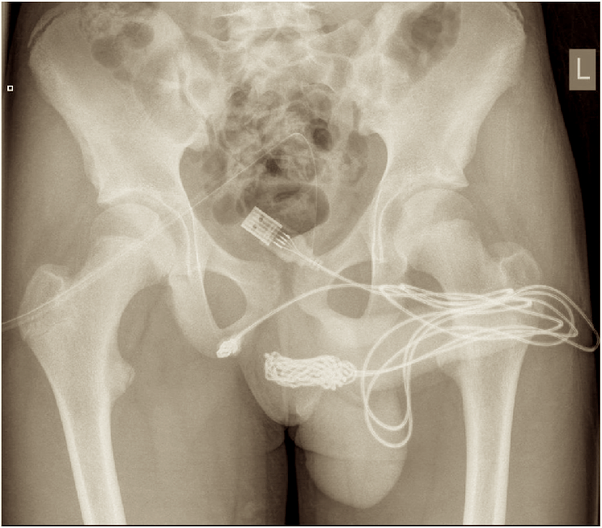
An X-ray was ordered immediately. What it revealed was far stranger than anyone expected.
The X-Ray That Revealed the Unthinkable
The images showed a long, coiled object filling the patient’s bladder—with one end dangling out of his urethra. It wasn’t just a small foreign body. It was a 6-meter (20-foot) plastic cable, tightly packed inside him.
Doctors were stunned. How did it get there?
The patient still claimed he had no idea.
Emergency Surgery: A Race Against Obstruction
This wasn’t just an oddity—it was a medical emergency. The cable had completely blocked his bladder, risking infection, kidney damage, or even rupture. Surgeons rushed him into the OR, where they carefully extracted the massive, rolled-up cable.
Only after the procedure did the truth come out.
The Reluctant Confession
The patient, later nicknamed “Cable Guy” by the medical team, finally admitted he had inserted the cable into his urethra for sexual pleasure. Even more alarming? This wasn’t his first time.
He had a history of inserting foreign objects into his body—a compulsive behavior linked to severe mental health struggles.
A Recurring (and Dangerous) Problem
Unfortunately, Cable Guy’s case wasn’t isolated. Doctors see patients like him more often than you’d think—people who insert objects (pens, wires, even small toys) into their urethras or bladders, often leading to:
✔ Severe pain and infection
✔ Urinary blockages
✔ Emergency surgeries
✔ Long-term damage
In Cable Guy’s case, his compulsions were so extreme that doctors knew he’d be back.
A Warning About Self-Inflicted Trauma
This bizarre case highlights a serious medical issue:
- Mental Health Matters – Compulsive behaviors like this often stem from untreated psychiatric conditions.
- The Dangers of “DIY” Pleasure – Inserting foreign objects can cause permanent harm.
- When to Seek Help – If you or someone you know struggles with harmful urges, medical and psychological support is crucial.
As one doctor put it:
“If Cable Guy enters the building, he won’t be leaving soon.”
Final Thought: A Medical Mystery with a Deeper Lesson
While this story might seem shocking (or even darkly humorous), it’s really about the intersection of mental health and risky behavior. The human body is fragile—and sometimes, the things we do to ourselves are far more dangerous than we realize.
If there’s one takeaway? Don’t try this at home.
In the high-stakes world of emergency medicine, few cases capture the urgent interplay between mental health crises and physical trauma as dramatically as the story of “Cable Guy.” This bizarre medical mystery—involving a 6-meter plastic cable lodged in a patient’s bladder—reveals critical lessons about compulsive behavior, psychiatric treatment gaps, and the staggering medical costs of self-inflicted injuries. For healthcare professionals and the public alike, this case underscores why addressing mental health struggles early can prevent life-threatening emergencies.
The ER Visit That Baffled Doctors: A Urinary Tract Infection Turned Nightmare
When the 34-year-old patient arrived at the ER with excruciating pelvic pain and a mysterious green string protruding from his urethra, doctors initially suspected a severe urinary tract infection or kidney stones. But the truth was far stranger. The urologist on call, Dr. Emily Carter, described the scene: “The patient was writhing in pain, yet he couldn’t explain how the object got there. We knew we were dealing with something unprecedented.”
An immediate X-ray revealed a chilling sight: a 6-meter (20-foot) plastic cable coiled inside his bladder, with one end dangling through his urethra. The discovery triggered a race against time—the cable had caused a complete urinary blockage, risking kidney failure, sepsis, or bladder rupture.
Emergency Surgery: Extracting the Cable and Uncovering the Truth
The surgical team faced a delicate challenge: removing the tightly wound cable without tearing the bladder or urethra. Dr. Carter recalls, “We’d never seen a foreign object of this size. One wrong move could lead to permanent damage or hemorrhage.”
After a 3-hour procedure, the team successfully extracted the cable. But the bigger question remained: Why would someone do this?
Post-surgery, the patient—dubbed “Cable Guy” by staff—confessed. He’d inserted the cable for sexual gratification, a compulsive act tied to untreated mental health issues. Shockingly, this wasn’t his first incident. “He admitted to prior episodes, but shame kept him from seeking psychiatric treatment,” said Dr. Carter.
The Alarming Prevalence of Self-Inflicted Injuries: Statistics and Risks
Cable Guy’s case is not an outlier. A 2022 Journal of Urology study found that 12% of urologic emergencies involve self-inserted objects, often linked to:
- Mental health crises: 68% of patients have diagnosed OCD, schizophrenia, or substance abuse disorders.
- Sexual curiosity: 25% involve misguided attempts at stimulation.
- Social isolation: 40% of cases occur in individuals lacking access to mental health resources.
Common Objects Found
| Object | Frequency | Health Risks |
|---|---|---|
| Wires/Cables | 32% | Perforation, infection, blockages |
| Toys | 18% | Urinary retention, sepsis |
| Household items | 22% | Organ damage, emergency surgery |
Mental Health and Compulsive Behavior: Why Early Intervention Matters
Cable Guy’s actions point to a severe, untreated compulsive disorder. Dr. Laura Simmons, a psychiatrist specializing in impulsive behaviors, explains: “Such acts often stem from a cycle of shame, temporary relief, and escalating risk-taking. Without therapy or medication, patients face recurrent trauma.”
Barriers to Treatment
- Stigma: Fear of judgment prevents 60% of patients from seeking help.
- Cost: 35% lack health insurance coverage for mental health services.
- Awareness: Many don’t recognize compulsive behavior as a psychiatric condition.
The Financial Toll: Medical Costs and Insurance Implications
Self-inflicted injuries carry staggering costs. Cable Guy’s surgery alone exceeded $25,000, not including post-op care or psychiatric treatment. For uninsured patients, such emergencies can lead to bankruptcy.
Average Costs of Common Complications
- Emergency surgery: 15,000–15,000–50,000
- UTI treatment: 1,500–1,500–3,000
- Psychiatric hospitalization: $10,000/week
Health Insurance Coverage Gaps
Only 45% of U.S. insurance plans fully cover mental health and self-harm-related procedures, leaving families vulnerable.
A Warning from Healthcare Professionals: When to Seek Help
Doctors urge anyone struggling with compulsive urges or self-harm to:
- Contact a mental health hotline: Free, confidential support is available 24/7.
- Explore therapy options: CBT and medication can reduce harmful behaviors.
- Secure insurance: Verify coverage for psychiatric treatment and emergencies.
Dr. Carter’s stark warning: “What starts as a curiosity can escalate to a life-or-death scenario. Don’t wait until you’re in the ER.”
Legal and Ethical Dilemmas: Patient Confidentiality vs. Public Safety
Cable Guy’s case raises tough questions: Should doctors report self-harm to authorities? How can hospitals balance patient confidentiality with community safety? Most states mandate reporting only if there’s imminent danger to others, but laws vary.
Conclusion: A Call for Compassion and Proactive Care
While Cable Guy’s story shocks and fascinates, it’s a grim reminder of the consequences of untreated mental illness. By prioritizing access to psychiatric care, expanding health insurance coverage, and reducing stigma, we can prevent such tragedies.
Final Takeaway: If you or someone you love faces a mental health crisis, act now—early intervention saves lives, reduces medical costs, and prevents trauma.
Need Help?
- National Suicide Prevention Lifeline: 1-800-273-TALK (8255)
- Substance Abuse and Mental Health Services Administration (SAMHSA): 1-800-662-HELP (4357)