
Heads up: some links are affiliate, so I may earn a tiny commission (at no extra cost to you!) on stuff I genuinely adore. Please read my Disclosure Policy for additional information.
If you carry your weight through the middle with great legs and a lovely neckline, congratulations, you’re an apple shape, and you’ve probably been given terrible advice about it for years. Hide it. Cover it. Size up. Wear the tunic.
All wrong. Apple shapes look best in clothes that create length, not clothes that create coverage. Once you understand that, dressing gets so much easier, and honestly, kind of fun again.
Here are the twelve rules, plus the one outfit formula that does all of them at once.
1. Create a Long Vertical Line
This is the number one trick, full stop. Open blazers, long cardigans, long necklaces, V-necks, open button-downs, monochrome outfits. Anything that draws the eye up and down instead of across your middle.
Pro tip: You only need one strong vertical per outfit, but two is even better. An open cardigan plus a long pendant is the easiest double-vertical there is, and you probably own both already.
2. Choose Clothes That Skim Your Stomach
The sweet spot is neither skin-tight nor enormous. You want fabric that grazes your body and floats over the middle without clinging or tenting.
Pro tip: Do the pinch test in the fitting room. If you can pinch more than two inches of loose fabric at your waist, it’s too big. If you can’t pinch any, it’s too tight. That gap is your fit.
3. Make V-Necks Your Best Friend
V-necks, open collars, and scoop necks pull the eye upward and add visible length to your torso. They’re especially powerful under an open jacket or cardigan, because the V and the lapels work together.
Pro tip: If you’d rather not wear an actual V-neck, unbutton the top two buttons of any shirt or wear a long pendant over a crew neck. You get the same vertical effect with the coverage you prefer.
4. Wear Structured Jackets Open
A single-breasted blazer worn open is a powerhouse for apple shapes. Those two lapels create long vertical lines down your front, while the structure balances your shoulders and frames your torso beautifully.
Pro tip: Choose a blazer that ends below your hip, not at your stomach, and never button it. If the buttons pull even slightly when closed, size up in the jacket only, and wear it open as intended.
5. Get the Pants Right
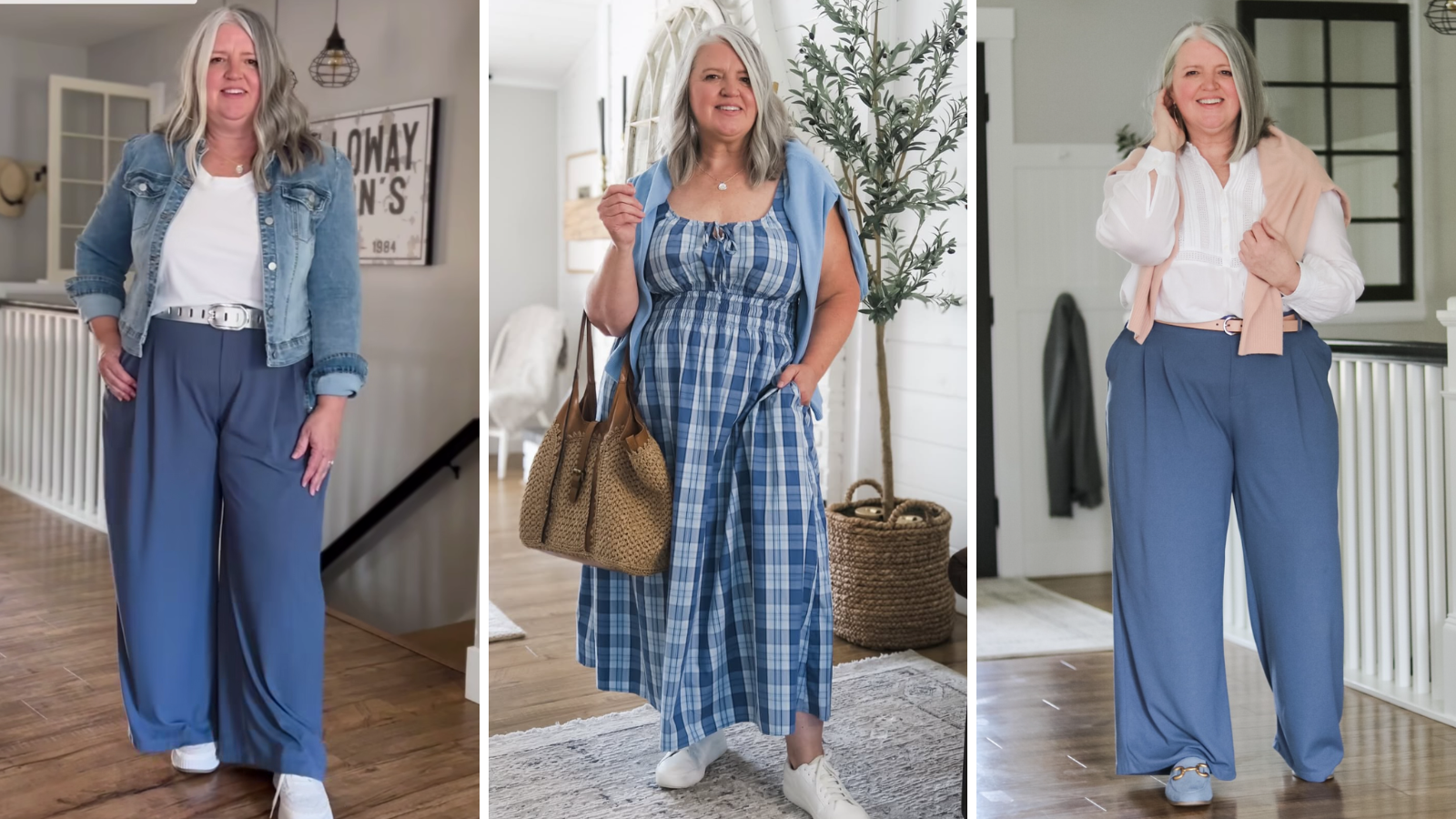
Straight-leg, bootcut, and fluid wide-leg trousers are your easiest wins. The waistband should sit comfortably without digging, and the fit through hips and thighs should be clean rather than squeezed.
Pro tip: Apple shapes usually have great legs, so let the trousers do some showing off. A slightly flared or wide leg also balances the torso visually, which makes everything above look narrower.
6. Use Monochrome Outfits
One color head-to-toe is the fastest way to look longer and more streamlined. Black with black. Navy with navy. Chocolate with chocolate. Cream with beige. Then add contrast with a jacket, shoe, or handbag.
Pro tip: The contrast piece should be vertical or at the extremities, an open jacket, shoes, a bag, not a contrasting belt or waistband. Keep the middle of the column uninterrupted and the whole trick holds.
7. Stop Automatically Sizing Up
This is the big one, and it’s the most common mistake I see. Sizing up to hide your stomach usually makes an apple shape look larger, because shapeless fabric adds bulk wherever it lands.
Pro tip: The rule is one relaxed piece, one structured. Wide pants with a cleaner top. Relaxed blouse with straight trousers. Oversized cardigan with a streamlined outfit underneath. Never relaxed on relaxed.
8. Wear Dresses That Skim, Not Cling
A-line, faux-wrap, fit-and-flare, and softly structured shift dresses are made for you. And fabric matters enormously here, more than the cut does.
Pro tip: A substantial fabric that glides over the body beats thin clingy jersey every single time. Do the scrunch test: if it wrinkles the moment you grip it or you can see your hand through it, it will cling. Put it back.
9. Avoid Horizontal Lines at Your Widest Point
Watch out for jackets ending right at your stomach, tops ending at the widest part of your hip, contrasting waistbands, and wide belts cutting straight across your middle. Hems and color breaks are horizontal lines, and wherever they land is where the eye measures.
Pro tip: Before buying, look at where the hem falls in the mirror and ask one question: is this my narrowest point or my widest? Move the hem two inches in either direction and the whole outfit changes.
10. Show Your Slimmer Areas
A little wrist, ankle, forearm, or neckline makes an entire outfit feel lighter. Three-quarter sleeves, ankle-length trousers, open necklines, streamlined shoes.
Pro tip: Show two slim points, not one. Pushed-up sleeves plus visible ankles reads relaxed and intentional; covered everywhere with one sliver showing just looks like the sleeves are the wrong length.
11. Define the Waist Without Squeezing It
You don’t need a small waist to suggest one. A French tuck, a gently shaped jacket, a faux-wrap dress, or a belt placed at your narrowest point (often higher than you’d expect) all create definition without compression.
Pro tip: Find your actual narrowest point by bending sideways, wherever your body creases is your natural waist, and it’s usually higher than where you’ve been putting your belts. Define there and everything lengthens.
12. Don’t Be Afraid of Fitted Clothes
Fitted does not mean tight. A beautifully fitted blouse or jacket is far more flattering than a giant tunic, because it follows your shape instead of grabbing it or hiding it.
Pro tip: If you’re nervous, start with fitted on top of relaxed underneath, a fitted blazer over a skimming shell, or a fitted shirt worn open over a tank. You get the shape and the comfort at once.
The Golden Formula
If I could give you one outfit and nothing else, it would be this:
V-neck top, straight or wide-leg trousers, open structured blazer, streamlined shoes, long necklace.
That single combination gives you length, balance, structure, and waist definition all at once, and not a single piece of it requires you to hide your body. Build it in one color for extra elongation, swap the blazer for a long cardigan on casual days, and you’ve got a uniform that works for the next decade.
Your body isn’t a problem to solve. It’s just a shape, and now you know exactly how to dress it.
related articles to How to Dress an Apple Shape Over 50